
Filter by category


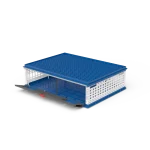
Quail Coop
A strong and practical transport crate for quails and gamebirds, designed for safe handling, easy access and long-lasting use.


Pheasant Coop
A secure and well-ventilated transport crate for pheasants and gamebirds, designed to limit light exposure and ensure practical handling.


Get your quote now!
"*" indicates required fields
Advanced Filters
114 products found
 Layer
 Broiler
Breeder
 Ruminant
 Pig
 Sheep
 Chick
 Rabbit
 Duck
 Turkey
Pigeon
Pheasant
Quail
Pheasants react faster than farm poultry. They flap, they jump and they hurt themselves against anything hard or open. Game bird operations know the pattern: a calm bird arrives in good condition, and a startled bird does not. That is why the crate for a pheasant is built on a different principle than a broiler coop. It gives the bird shade and air at the same time.
What do pheasant transport crates have to do?
A pheasant transport crate has to keep the bird quiet during loading, driving, and unloading. Light is the first trigger, because a bright crate invites the bird to move towards the opening. Noise and vibration add to that, and a nervous bird in a small space damages its own wings. The crate therefore has to be closed enough to calm and open enough to breathe.
The second job is protection during handling. Rounded shapes and smooth walls limit bruises and broken wings when staff lift and stack the crates. Pheasant cage transport also covers long distances in the game bird season. The crate has to hold its shape under a full load. The transport range is built from polyethylene for exactly that kind of repeated use.
Less light, full ventilation
The Pheasant Coop has an exclusive design that limits the entry of light while it still ensures perfect ventilation. Those two requirements usually pull in opposite directions. More openings mean more air and more light, and a closed box gives calm without fresh air. Giordano solved that with the shape of the walls rather than with fewer holes.
Pheasant transport crate ventilation matters most when the load stands still. A stack in the yard or on a waiting truck holds warm air between the crates. Air that keeps moving through the whole stack carries that heat away from the birds. The same openings help during the wash, because water and air reach every corner of the crate.
Choosing the door you need
The Pheasant Coop comes with two doors or with three doors. Two doors sit on the side of the crate, which suits a team that loads at waist height. The third door sits on top and measures 18.5 x 14 cm. One person can place birds from above without opening the full side. A pheasant transport box with a top door also shortens the moment the crate stands open.
Door choice follows your catching method, not the other way around. A side-swinging door of 28 x 18 cm is available as a spare part for both versions. Springs and spring holders keep the doors closed under load and are supplied separately. That means a door that starts to hang gets replaced instead of the whole crate.
A stack that stays together
The Pheasant Coop is built for good overlapping between the different pieces, solid and secure. Crates that sit into each other keep the stack in one block when the truck turns or brakes. A load that shifts costs time at the destination and unsettles the birds on the way. The overlap does that work without straps or extra frames.
Stacking also decides how much you carry per trip. A game bird transport crate that stacks square uses the full height of the truck bed. Empty crates go back in the same way, so the return trip stays cheap. In a season with fixed release dates, that rhythm counts for more than a few centimetres of crate space.
Smaller game birds require a different design
Smaller species need their own format. The Quail Coop is made for quail and game birds. It measures 675 x 450 x 150 mm and weighs 2.3 kg. It has two doors, a full bottom, and rounded surfaces that limit bruises and broken wings. The coop ships fully assembled and is made of heavy-duty polyethylene.
The logistics are easy to plan. One pallet of 1350 x 1150 x 2250 mm holds 75 coops. A 20-foot container takes 640 units, a 40-foot container 1,360, and a 40-foot high cube 1,530. The top door, the spring and the spring holder are the same parts as on the pheasant version. One stock of spares covers both crates.
Buy your products at Giordano Global
Giordano Global has designed plastic products for the professional poultry sector for more than 60 years. Next to the crates for broilers and turkeys, the range covers game birds, quail and pigeons with matching door sizes. A plastic pheasant crate uses the same material and spare parts as the rest of the transport line. Seven business units serve customers on every continent.
Do you have a question?
If you have any questions or require further information, please reach out to us!
Frequently asked questions
What are the key differences between Giordano day-old chick crates compared to other suppliers?
Giordano’s day-old chick crates are made from high-quality, UV-resistant plastics (PEHD/PP), ensuring durability and functionality in temperatures from -15°C to + 50°C. Their ergonomic design simplifies handling, offers better ventilation to promote chick welfare and ensures easy cleaning for improved hygiene. Giordano also provides modular systems that integrate seamlessly into logistics processes, boosting transport efficiency. Known for innovation, their products feature advanced technologies and customization options, making them a durable and efficient choice. Even if initial costs are higher than competitors.
What are the best crates to transport pigeons?
The best crates for transporting pigeons ensure their safety, comfort and well-being. They should provide adequate space without overcrowding and include multiple compartments to reduce stress. Proper ventilation is crucial to maintain airflow and prevent overheating, while durable yet lightweight like high-quality plastic or metal enhance portability. Crates should have hygienic, easy-to-clean designs, secure latches and smooth interiors to prevent injuries. Features such as comfortable flooring, sturdy handles, stackability and compliance with transport regulations ensure convenience and reliability. Giordano’s plastic pigeon creates are a recommended choice, offering durability, ventilation and easy cleaning for safe transport.
Is it easy to assemble the coops of Giordano myself?
Giordano coops are designed for easy self-assembly with their modular systems and lightweight, durable materials. They come with detailed instructions, often requiring minimal tools like a screwdriver or pliers. To ensure smooth assembly, prepare by checking all components and reading the instructions beforehand. Assembly is usually manageable solo but can be quicker with help. After assembling, verify the coop’s stability and choose a suitable location for placement. With user-friendly designs, Giordano coops are straightforward to assemble, even for those with limited DIY experience.
Why do chicken coops often have more than 1 door?
Chicken coops often have multiple doors for practical reasons: easier access for cleaning and egg collection, improved ventilation, increased safety with escape routes, separation of areas like nesting and feeding zones, and convenience for managing larger flocks. Overall, multiple doors in a chicken coop contribute to better management, safety, and comfort for the chickens. Giordano offers a wide range of coops from no door to 3 door solutions.
How many day-old chickens can be loaded in a chick box?
The capacity of a chick crate’s compartments, specifically for day-old chicks, typically depends on the crate’s design and size, which varies. Standard crates [600×400] usually accommodate up to 100 chicks per crate. The two compartments can therefore hold 50 birds per compartment and the four-compartment crate could potentially hold 25 chicks per compartment.
Key factors influencing capacity include chick size, crate ventilation, and transportation distance. Manufacturers and poultry farms often provide guidelines on crate capacity to ensure the welfare of the chicks. Giordano offers a wide variety of crates from 1 to 4 compartments.