
Filter by category


HCS
The HatchCargoSystem® loads 40% more hatching eggs per truck and reduces return load by 55%, replacing steel farm carts.
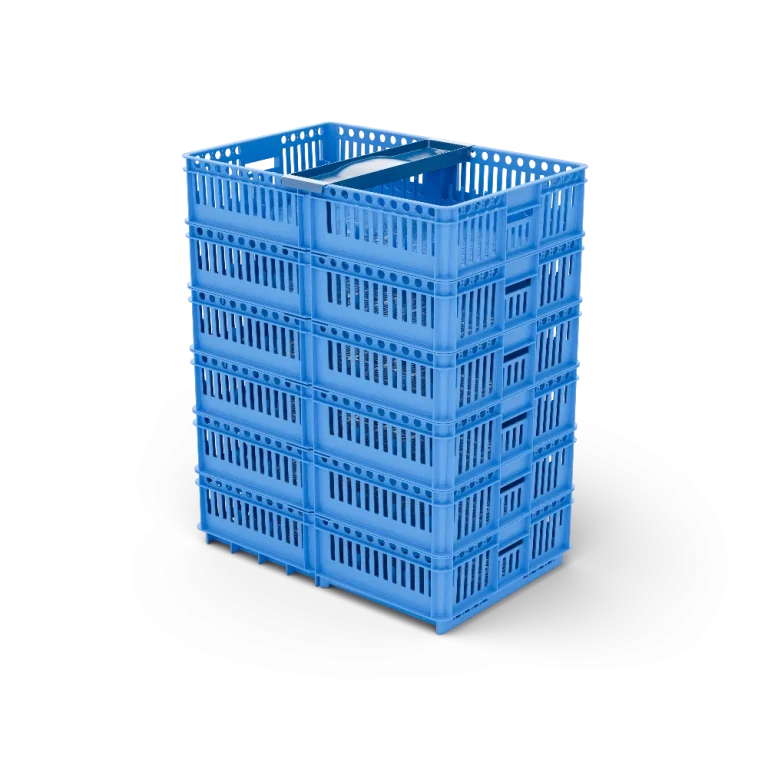

HCS Prolife®
HCS+ ProLife®
Get your quote now!
"*" indicates required fields
Advanced Filters
113 products found
 Layer
 Broiler
Breeder
 Ruminant
 Pig
 Sheep
 Chick
 Rabbit
 Duck
 Turkey
 Pigeon
 Pheasant
 Quail
A hatchery works to a clock. Eggs come in from the breeder farm, spend days in the setter and leave as chicks within hours of hatching. Every handling step in between costs time and adds risk. The carrier you use decides how much of that time you keep. The Hatch Cargo System replaces loose trays and steel trolleys with one plastic unit that runs through the whole process.
What a hatchery cargo system does
The hatchery cargo system is the carrier that holds hatching eggs from the breeder farm to the setter. Hatching egg systems work differently from table egg systems. Table eggs go to a packing station and leave the chain. Hatching eggs stay inside your building for three weeks and need air, space and a fixed position.
The HatchCargoSystem (HCS) is built for that route. It gives hatchery egg transport a single format that fits the truck, the storeroom, and the setter room.
Three parts, one system
The system has three parts. The setter tray holds 150 eggs and stacks and nests. The HCS pallet forms the base and is shaped so air moves through the load as efficiently as possible. The HCS clip connects the trays and keeps a stack safe during handling.
The pallet measures 1030 x 755 x 160 mm and weighs 10.7 kg. Water injection technology keeps that weight low, which makes the hatchery plastic equipment easy for staff to move by hand.
More eggs per pallet, less space on the way back
One HCS pallet holds up to 7,500 eggs. That is 25% more than the 6,000 eggs on a traditional trolley. With robot stacking, the number rises to 8,400 eggs, an increase of 40%. The same floor space in your truck and your store room therefore carries more of your incubation.
Return transport is where hatchery logistics equipment usually costs money. Empty steel trolleys take up as much room as full ones. Empty HCS pallets and trays stack down and cut the return load by 55%.
Tracking and hygiene
Every HCS pallet carries an RFID chip as standard, a wireless technology that uses radio waves to identify, track, and communicate information. The pallets and trays also carry an individual barcode. This way you can follow each setter tray through the chain. That turns hatchery egg management into a matter of reading data instead of counting trolleys.
Commercial hatchery equipment has to survive daily washing. The HCS trays and pallets work with existing washing equipment, so your cleaning routine stays the same. Clean compound is available as an option. It uses silver ions to slow the growth of bacteria and other harmful micro-organisms.
From setter to hatcher and on to the farm
Setter-to-hatcher transport stays inside the same system. The tray that brought the eggs from the breeder farm also works as your egg incubation transport system. Existing robots pick the trays from the pallet and place them into pre-hatch trolleys. Hatchery automation keeps running because the tray shape and the stack height stay the same on every pallet.
The trays sit fixed in the stack and do not bounce during transport, which protects the embryo inside the egg. Electric pallet jacks handle the loads, so staff lift less. Colours and inscriptions are available on request.
Hydration and early feeding after the hatch
Chicks lose weight and moisture in the hours between hatching and first feed. The HCS ProLife crate answers that with drinking water and feed inside the crate itself. Giordano calls it the first and only system of its kind. Chicks get direct access to fresh water and feed in storage and on the road. The solution is patented.
Water runs through gutters on the sides and flows down to the crates below. Feed and water are reachable from two sides of the crates. The gutters are shaped so chicks cannot sit on them, which keeps the water clean. Day-old transport hydration and day-old storage hydration therefore run on the same set of crates.
What the early feeding system delivers
An early feeding system reduces dehydration and body weight loss in the first days. It also supports early gut development and nutrient absorption, so chicks arrive at the farm in more even condition. Holding periods can be longer, and transport distances can be greater.
Hatching crates, including hydration, also help you meet welfare standards and legal requirements. The ProLife crate follows the standard chick crate size of 600 x 400 mm. It fits existing storage infrastructure with minimal changes. Your early feeding program then continues from the hatchery to placement on the farm.
Giordano Global is a hatchery equipment supplier with more than 60 years of experience. The company designs and produces plastic products for the professional poultry sector. Our seven business units serve customers on every continent. Interested in cargo systems for your poultry farms? Get in touch with us to see how we can provide you with your needs.
Do you have a question?
If you have any questions or require further information, please reach out to us!
Frequently asked questions
Do duck eggs require a special egg tray?
Ducks are generally larger than chicken eggs, so they may not fit in a standard chicken egg tray. To store duck eggs properly, you can consider two options. You can look for special egg trays designed for larger eggs, which have bigger compartments to accommodate the size of duck eggs. You can also consider multi-size Egg Trays, which can be adjustable or come in multiple sizes to fit different egg sizes. Ensure the storage method keeps the eggs stable and safe from cracking.
What are the advantages of a plastic egg crate compared to corrugated boxes?
Plastic egg crates offer several advantages over corrugated boxes for storing and transporting eggs. They are more durable, resisting moisture and pressure damage, and offer reusability by being easy to clean and sanitize, reducing waste and costs. Their rigid structure provides better protection for eggs, minimizing breakage during transit. Additionally, plastic crates excel in hygiene by avoiding moisture absorption and bacterial buildup, making them safer for food handling. Their stackable design optimizes space and stability, while customization options like handles or locking mechanisms enhance functionality. Giordano offers her Lindamatic egg crates which are the perfect solution for transport and protection of eggs.
Does Giordano offer solutions for the transportation of quail and quail eggs?
Yes, Giordano Global offers solutions for the transportation of quails and quail eggs. They have special transportation solutions and packaging materials that are designed to transport quails and their eggs safely and efficiently. Think about the well-designed coops and the special egg trays for 72 quail eggs. You can contact Giordano Global for more information about their products and services for the transportation of quails and quail eggs.
Can an egg tray with one cup size safely carry all kinds of chicken eggs?
An egg tray with one cup size can carry a variety of chicken eggs. Whether it can do so safely depends on the size of the cups and the range of egg sizes it needs to accommodate. Most trays accommodate medium to large eggs, commonly produced in commercial settings, but smaller eggs may be unstable, and jumbo eggs might not fit securely. Deep or conically shaped cups provide better support for different sizes, reducing movement and breakage risks. Variations in egg size by breed or shell thickness also affect fit and safety. Flexible trays can adapt to different sizes, but operations handling diverse egg sizes may require multiple tray types. Giordano offers a wide range of egg trays all meant to protect the eggs the best possible way.
At what temperatures can I wash plastic egg trays?
Washing egg trays, particularly those made by Giordano, involves ensuring the trays are effectively cleaned without causing damage to the material. The specific minimum and maximum temperatures for washing Giordano egg trays would typically depend on the material of the trays and the manufacturer’s recommendation. There are some general guidelines. For effective cleaning, a minimum temperature of 40°C (104°F) is often recommended to help remove dirt and organic matter. To make sure the trays are safe from warping or degradation, the maximum temperature of 60-70°C (140-158°F) is recommended. It is also important to use the appropriate detergent and to let the products air-dry.