
Filter by category

ECS
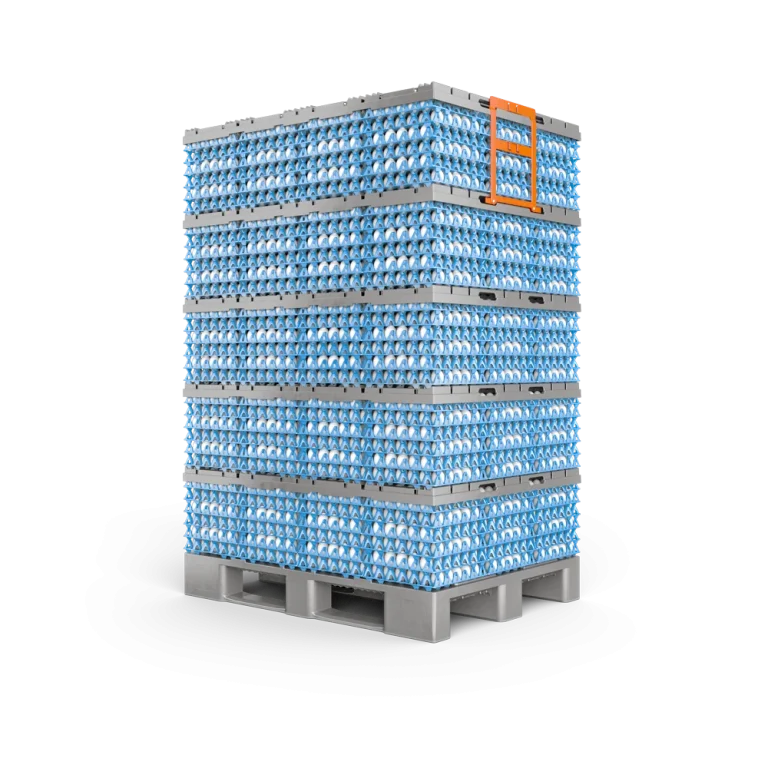
EggsCargoSystem® offers maximum egg protection with under 3% cracked, is fully recyclable and fits more eggs per truck.


ECS XL
EggsCargoSystem® XL is designed for larger eggs like duck and turkey, suits robot picking and holds up to 5760 eggs per pallet.

ECS Mini
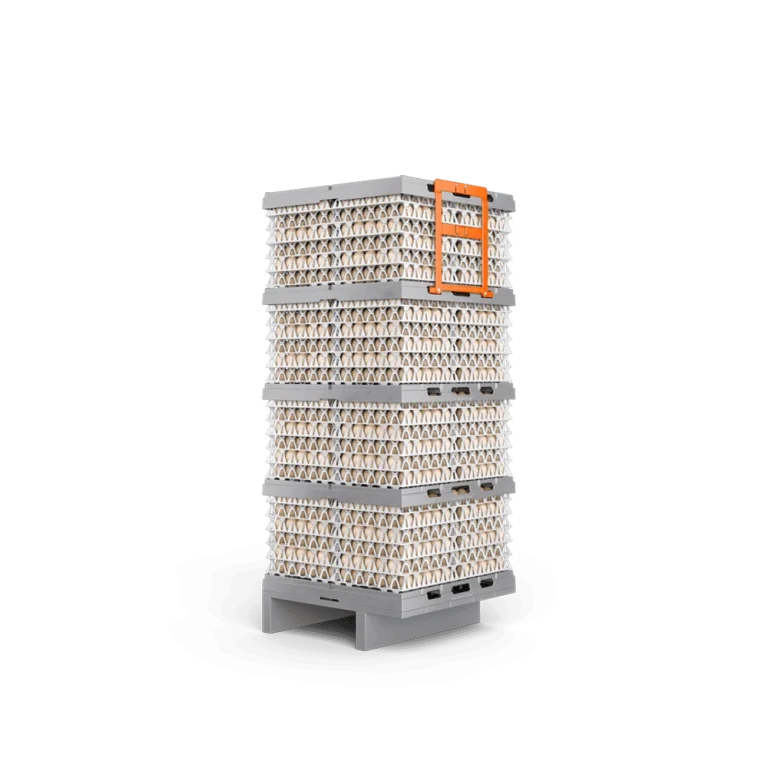
EggsCargoSystem® Mini uses a small pallet and smart dividers for 4 stacks, ideal for supplying caterers, fast food and retailers.
Get your quote now!
"*" indicates required fields
Advanced Filters
113 products found
 Layer
 Broiler
Breeder
 Ruminant
 Pig
 Sheep
 Chick
 Rabbit
 Duck
 Turkey
 Pigeon
 Pheasant
 Quail
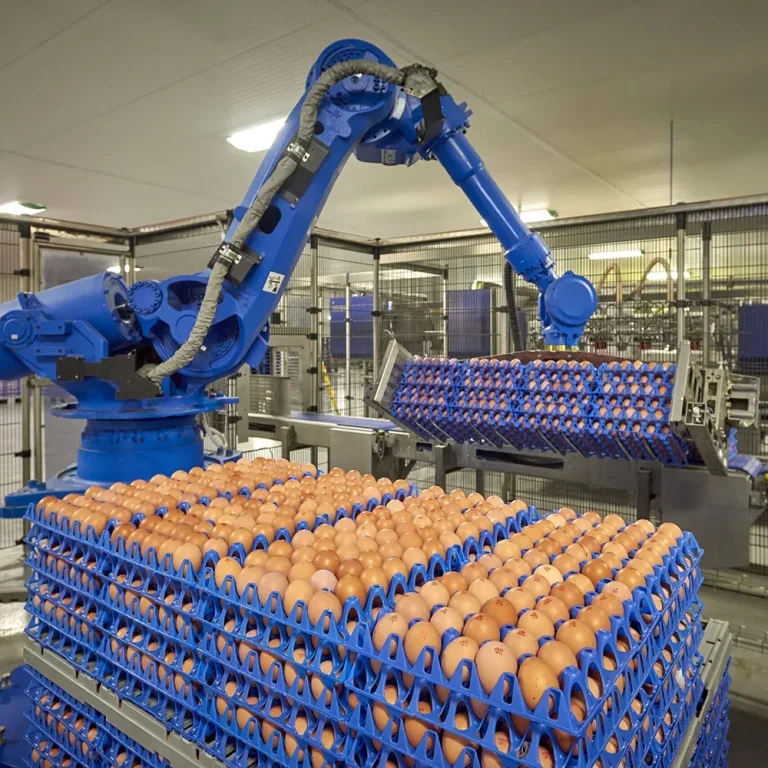
A modern layer house produces more eggs per hour than any person can carry by hand. Machines take over the lifting, stacking and loading. Those machines only work well when every load has the same shape and the same weight. That is the job of a cargo system. It turns loose trays of eggs into one fixed unit that a robot, a forklift, and a truck all understand.
What an EggsCargoSystem does
The EggsCargoSystem is the carrier that holds your eggs together from the layer house to the customer. Eggs arrive from the automated egg collection system in the house. A farm packer places them on trays and builds the stacks. From there the trays need a stable base and a fixed footprint. A good egg transport system keeps that shape identical from the first tray to the last truck.
Giordano introduced the EggsCargoSystem in 2000. More than 1,500 companies worldwide now work with it. The system replaces one-off paper trays with one repeatable unit. Your egg logistic system then stays the same on every farm, truck and packing centre.
The three parts of the system
The EggsCargoSystem contains 3 items: a plastic pallet, plastic dividers and plastic trays. The trays hold the eggs. The dividers separate the stacks and give robots a flat surface to grip. The pallet carries the whole load. Together, these parts form one egg pallet system with a fixed height, width and weight. That is what makes automated egg handling t possible. A robot then picks the same stack in the same place every time.
The pallet carries the load
The EC Standard Pallet measures 1200 x 900 x 160 mm and weighs 17.45 kg. It is made from high-quality HDPE, a strong plastic that keeps its shape for years. The pallet carries 1,100 kg while it moves and 4,500 kg when it stands still. In a rack, it holds 400 kg. The egg transport pallet poultry companies use most has a closed foot and rubber plugs as standard. Those plugs keep the egg stack from shifting. You can stack 15 pallets on top of each other and load 480 in one truck. A reinforced version is available for rack storage.
Dividers, protectors and trays
The divider is a plastic layer between two stacks of trays. It spreads the weight and lets the robot pick up a full stack in one movement. On top of the cargo comes a protector, which shields the highest layer during transport. Trays come in Standard, Jumbo 1.0, and Jumbo 2.0 for both consumption and hatching eggs. You choose the tray that matches your egg size, and the rest of the system stays the same. The EggsCargoSystem tray inspector guards tray quality and is able to identify crack in the trays. This camera system finds and removes broken trays at 2,500 trays per hour.
Choose the system that matches your eggs
Three versions cover almost every operation. The differences are in egg size, volume, and the type of customer you serve.
EggsCargoSystem Traditional
ECS Traditional handles chicken table eggs and hatching eggs. Four layers hold 8,640 eggs on one pallet. Five layers hold 10,800 eggs and six layers hold 12,960 eggs. .
EggsCargoSystem XL
ECS XL carries bigger eggs from ducks and turkeys, with hatching eggs as the main focus. The XL tray has a 5 by 4 layout. Four layers hold 5,760 eggs, and five layers hold 7,200 eggs. Robots can pick up and unpack the load in the same way.
EggsCargoSystem Mini
ECS Mini uses a small pallet with four dividers and 96 trays. One Mini pallet holds 2,880 eggs, which replaces eight traditional boxes. Giordano built it for supply to large institutions, catering services, fast food chains and retailers.
Hatching eggs travel a different route
Hatching eggs go to the incubator instead of the packing station, so they need their own carrier. The HatchCargoSystem uses setter trays for 150 eggs. The trays stack and nest, and smart clips connect them to each other. That makes the use r of separate metal trolleys superfluous. .
The HCS pallet is shaped so air moves through the load in the best possible way. Existing robots can pick the trays and place them in pre-hatch trolleys. Hatcheries keep their automation and gain a lighter, cleaner carrier.
Tracking, hygiene and automation
Egg transport automation runs on data as well as on plastic. The EC pallet comes with a provision for an RFID chip. An RFID egg pallet let you follow your equipment through the chain. You see which customer holds which pallets and when they come back. Hygiene is built into the material. GIORDANO Clean Compound uses silver ions to slow the growth of bacteria and other harmful micro-organisms on the surface. Giordano Clean Compound is available as an option..
One format, every machine
A turnkey egg packing solution still needs one carrier that every machine agrees on. More than 30 equipment manufacturers support the EggsCargoSystem. That makes it the shared format for egg handling automation poultry companies rely on. Your packer, your robot, and your customer all work with the same pallet.
Giordano Global has designed plastic equipment for the professional poultry sector for more than 60 years. Seven business units serve customers on every continent, so supply and support stay close to your operation.
Do you have a question?
If you have any questions or require further information, please reach out to us!
Frequently asked questions
Do duck eggs require a special egg tray?
Ducks are generally larger than chicken eggs, so they may not fit in a standard chicken egg tray. To store duck eggs properly, you can consider two options. You can look for special egg trays designed for larger eggs, which have bigger compartments to accommodate the size of duck eggs. You can also consider multi-size Egg Trays, which can be adjustable or come in multiple sizes to fit different egg sizes. Ensure the storage method keeps the eggs stable and safe from cracking.
What are the advantages of a plastic egg crate compared to corrugated boxes?
Plastic egg crates offer several advantages over corrugated boxes for storing and transporting eggs. They are more durable, resisting moisture and pressure damage, and offer reusability by being easy to clean and sanitize, reducing waste and costs. Their rigid structure provides better protection for eggs, minimizing breakage during transit. Additionally, plastic crates excel in hygiene by avoiding moisture absorption and bacterial buildup, making them safer for food handling. Their stackable design optimizes space and stability, while customization options like handles or locking mechanisms enhance functionality. Giordano offers her Lindamatic egg crates which are the perfect solution for transport and protection of eggs.
Does Giordano offer solutions for the transportation of quail and quail eggs?
Yes, Giordano Global offers solutions for the transportation of quails and quail eggs. They have special transportation solutions and packaging materials that are designed to transport quails and their eggs safely and efficiently. Think about the well-designed coops and the special egg trays for 72 quail eggs. You can contact Giordano Global for more information about their products and services for the transportation of quails and quail eggs.
Can an egg tray with one cup size safely carry all kinds of chicken eggs?
An egg tray with one cup size can carry a variety of chicken eggs. Whether it can do so safely depends on the size of the cups and the range of egg sizes it needs to accommodate. Most trays accommodate medium to large eggs, commonly produced in commercial settings, but smaller eggs may be unstable, and jumbo eggs might not fit securely. Deep or conically shaped cups provide better support for different sizes, reducing movement and breakage risks. Variations in egg size by breed or shell thickness also affect fit and safety. Flexible trays can adapt to different sizes, but operations handling diverse egg sizes may require multiple tray types. Giordano offers a wide range of egg trays all meant to protect the eggs the best possible way.
At what temperatures can I wash plastic egg trays?
Washing egg trays, particularly those made by Giordano, involves ensuring the trays are effectively cleaned without causing damage to the material. The specific minimum and maximum temperatures for washing Giordano egg trays would typically depend on the material of the trays and the manufacturer’s recommendation. There are some general guidelines. For effective cleaning, a minimum temperature of 40°C (104°F) is often recommended to help remove dirt and organic matter. To make sure the trays are safe from warping or degradation, the maximum temperature of 60-70°C (140-158°F) is recommended. It is also important to use the appropriate detergent and to let the products air-dry.